Choosing between IKEA and John Lewis is less about finding a universal winner and more about matching a sofa to your room, routines and budget. IKEA’s published sofa range and 10-year warranty make it a practical starting point for buyers who want configuration choice; John Lewis may still be the right shortlist candidate where its current product specifications, delivery terms and feel in person better meet your needs.
IKEA vs John Lewis sofas: the short verdict
Neither retailer is automatically the better sofa choice for every UK home. Start with the physical constraints: the room, access route, intended number of seats and whether the sofa will be used every day. Independent buying guidance stresses that comfort, purpose and how the sofa sits within its surroundings all matter, rather than price or style alone.
IKEA has a clearly published UK sofa category spanning 2-seater, 3-seater, chaise, corner and modular formats. Its category page also states that its sofas have a 10-year warranty. That gives IKEA a straightforward route for buyers comparing common room layouts and looking for an explicitly stated warranty position.
For John Lewis, do not assume an equivalent range, warranty, delivery offer or upholstery specification from this comparison alone: check the live product page and service terms for the exact model. It can be the better fit if the sofa you prefer meets your needs on dimensions, comfort, material and total cost, but those retailer-specific details need current first-party confirmation.
What UK buyers should compare before choosing
Before comparing retailers, decide what the sofa needs to do. A formal sitting room may favour a more upright, supportive shape and an upholstery choice suited to occasional entertaining. A busy family room may place more weight on usable seating, cleaning requirements and how the sofa works with everyday movement. In an open-plan room, scale and silhouette can also affect how well the seating zone is defined.
Measure the proposed position, then measure the route to it: doorways, hallways, turns, stairs and lifts. Record the sofa’s width, depth and height as well as the space needed for doors, recliners or a chaise to operate. A sofa that fits a floor plan can still fail at delivery access.
Then compare the details model by model. Check seat count, orientation of any chaise, removable or fixed covers, fabric composition and care guidance, legs, feet and assembly requirements. Comfort cannot be established from a retailer category page, so test in person where possible or use the product’s return and delivery terms to understand the risk before ordering.
Finally, compare total ownership value rather than headline price alone: delivery, assembly, care products, potential access complications and the terms that apply to the exact sofa. Sofa choice is inherently personal; independent editorial guidance likewise frames the best option around the buyer’s space, needs and aesthetic rather than a single ranking.
Where IKEA sofas can make more sense
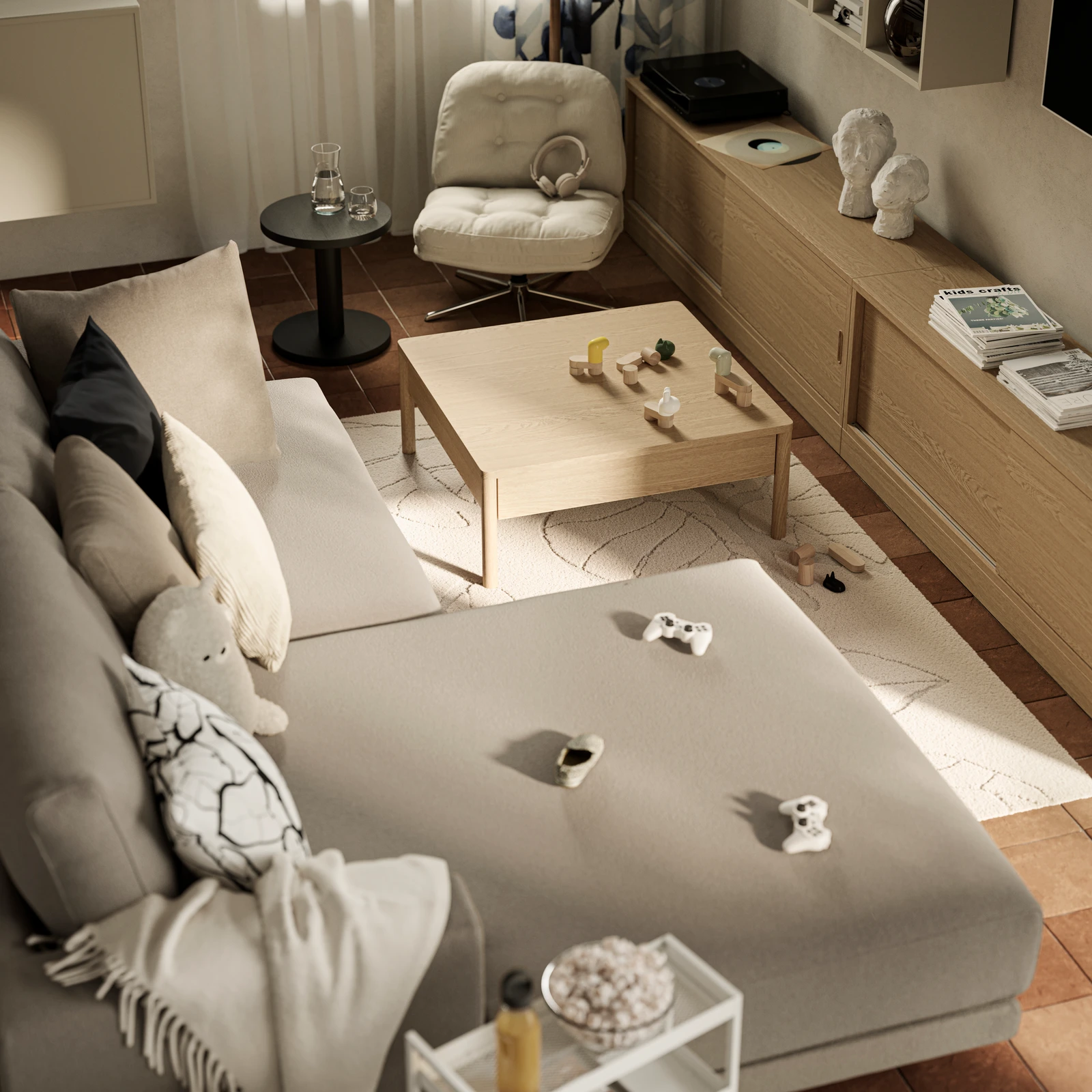 IKEA can make more sense when configuration is the first practical problem to solve. Its UK sofa category explicitly includes 2-seater, 3-seater, chaise, corner and modular sofas, so a buyer can begin with the format that suits a compact room, a corner or a more adaptable layout before narrowing down individual models.
It is also a useful first stop for buyers who want a published warranty statement at category level: IKEA says all its sofas come with a 10-year warranty. Read the applicable terms before treating that as a remedy for every type of wear, accidental damage or change of mind; the category statement does not replace the terms for your order.
Assembly is another point to check rather than presume. IKEA’s sofa page says assembly can be booked through Taskrabbit in store and online. Confirm availability, cost, scope and whether the service covers your postcode and chosen product before relying on it.
IKEA is therefore a particularly sensible shortlist route if you are working backwards from a specific footprint, need to compare several familiar sofa formats, or value an explicitly stated warranty alongside a clearly structured category. It is not evidence that every IKEA model will be the most comfortable, cheapest after delivery, or best made for every household. Use the live dimensions, materials, care notes and reviews for the individual model as the deciding evidence.
Where John Lewis sofas can make more sense
John Lewis can make more sense when the best choice is driven by a particular model’s upholstery, proportions, service terms or in-store comfort rather than by a retailer-wide category proposition. A sofa is a central, long-lived piece of a living space, and independent guidance recommends defining the purpose of the room and the support or upholstery priorities before selecting one.
That principle can favour John Lewis if an available sofa fits your measurements and feels right when tested, while its current product page gives satisfactory evidence on construction, fabric care, delivery access and applicable guarantees. For a formal room, for example, buyers may prefer the appearance and support of a particular upright design; for a family room, usable seating and maintenance may matter more.
However, this evidence pack contains no current John Lewis first-party product, warranty or delivery source. Do not infer that it has a specific range breadth, material standard, warranty length, assembly option, replacement-parts policy or price position. Verify those points against the exact live listing and the retailer’s current service pages.
The practical case for John Lewis is therefore model-led rather than a blanket verdict: shortlist it where a real, currently available sofa meets your design and ownership priorities, then compare its documented terms directly with the IKEA model you would otherwise buy.
Limitations and checks before you order
A comparison article cannot tell you whether a particular sofa will be comfortable for you. Sit on it where possible, considering seat depth, seat height, back support and how it feels when you use it in the way you normally would. Comfort and room fit are core buying considerations in independent sofa guidance.
Check every measurement against both the room and the delivery route. Include skirting, radiators, opening doors, stair turns and the space needed to manoeuvre packaging. For a corner, chaise or modular layout, draw the orientation on the plan so that the longest section does not block circulation or a window.
Read the exact listing rather than relying on a retailer name. Confirm fabric or leather type, care instructions, cover removability, frame and suspension information where supplied, feet, assembly steps, delivery charge, lead time, room-of-choice service, returns and warranty or guarantee exclusions. Availability and service details can change, so verify them at checkout.
For IKEA, the published 10-year warranty and Taskrabbit booking reference are useful starting points, but the applicable terms, service coverage and costs still need confirmation for the specific order. For John Lewis, obtain the equivalent current first-party information before deciding that a higher or lower ticket price represents better long-term value.
IKEA vs John Lewis sofa comparison table
| Criterion | IKEA | John Lewis | What to decide |
|---|---|---|---|
| Room formats | IKEA’s UK sofa category lists 2-seater, 3-seater, chaise, corner and modular sofas. | Current range and configurations are not evidenced here; verify on live product pages. | Start with the footprint and orientation your room permits. |
| Warranty evidence | IKEA states that all its sofas come with a 10-year warranty; check the terms for the model and claim type. | No current first-party warranty evidence is supplied. | Compare the applicable written terms, exclusions and claim route. |
| Assembly | IKEA says assembly can be booked through Taskrabbit in store and online; confirm local availability and cost. | No current assembly-service evidence is supplied. | Decide whether you can assemble, or need a paid service. |
| Comfort | A category page cannot establish comfort for an individual sofa. | The same limitation applies. | Test where possible and compare seat depth, height and back support. |
| Upholstery and care | Verify the selected model’s material and care information. | Verify the selected model’s material and care information. | Match maintenance requirements to children, pets and everyday use. |
| Construction evidence | Use the exact product listing for any frame, suspension or cushion claims. | Use the exact product listing for any frame, suspension or cushion claims. | Compare documented details, not retailer reputation alone. |
| Delivery and access | Check delivery options, charges and access requirements for the order. | Check delivery options, charges and access requirements for the order. | Measure doors, halls, stairs and turning points before purchase. |
| Total value | Compare price with configuration, warranty terms, delivery and any assembly cost. | Compare price with documented specifications, delivery and applicable terms. | Choose the option that best fits the room and expected years of use. |
The table is intentionally asymmetric where the supplied evidence is asymmetric. IKEA’s published category information supports a comparison of formats, warranty statement and assembly-booking reference. It does not support a universal quality ranking. John Lewis should be compared only once the current model-level facts are in front of you.
Choose by room, lifestyle and budget
AI-generated generic editorial illustration — not a retailer product photo and does not depict the reviewed product or service. Illustration supporting this section.
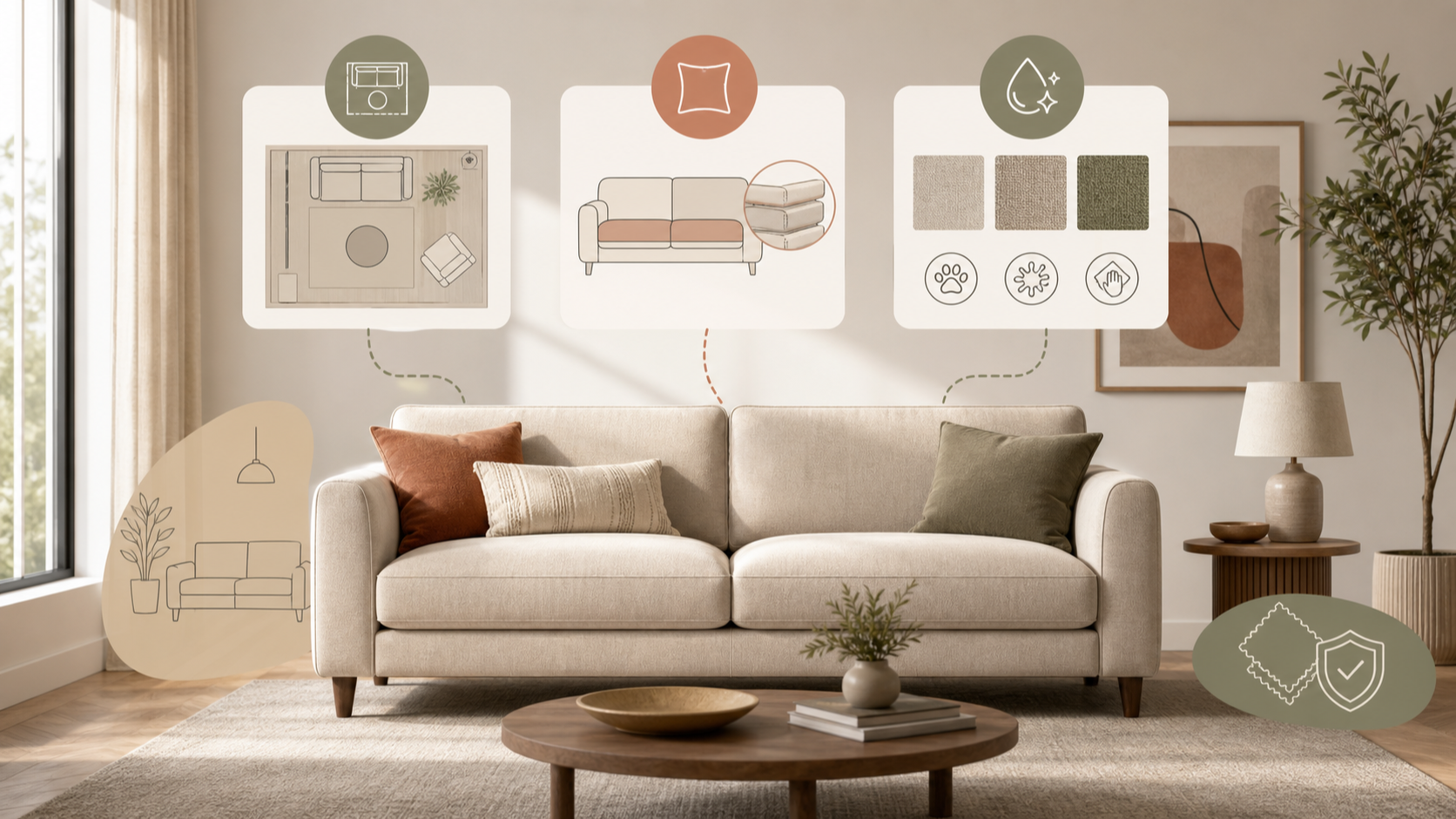 For a small room, begin with measured clearance and the smallest seat count that genuinely serves your household. A 2-seater may be easier to place, but depth and arm width can matter as much as nominal seat count. IKEA’s published category includes 2-seater options; compare their full dimensions with any John Lewis alternatives you find.
For a room that needs to accommodate several people or define a seating zone, consider whether a corner, chaise or modular layout solves the plan better than a conventional straight sofa. IKEA explicitly lists all three formats, but a modular layout is only worthwhile if its joins, orientation and total footprint work in your room. Do not buy flexibility at the cost of blocked circulation.
For family use, make care information and real-life comfort central. Choose fabric or leather only after checking the manufacturer’s care guidance, removable-cover details where relevant and how the seating feels. For a formal room, visual presence and supportive posture may take priority; independent advice notes that plush upholstery and a more upright or high back can suit that use.
For renters and budget-sensitive buyers, calculate the whole purchase: sofa price, delivery, assembly if needed, access risk and what the written warranty or guarantee actually covers. IKEA offers published configuration breadth and a 10-year warranty statement. John Lewis may still be worth the comparison if a documented model better serves your needs, but verify its current terms before assigning it a long-term-value advantage.
Alternatives worth considering
If neither retailer produces a sofa that fits your space or priorities, widen the search by requirement rather than by a generic “best retailer” list. A buyer who needs a reconfigurable layout can investigate modular sofas; someone with a tight delivery route may prioritise models with manageable components; someone furnishing a formal room may compare support, upholstery and silhouette across specialist upholstery retailers.
Independent editorial coverage shows that sofa options span budget, luxury, corner, storage, modular, traditional, sofa-bed, curved, leather and small-space categories. That breadth is a reminder to define the type of sofa first, then compare retailers that actually offer it.
Keep the same checklist: confirmed dimensions, delivery access, material and care information, a test of comfort where possible, and current written aftercare terms. Avoid treating an editorial shortlist as proof that a particular model is available, suitable for your home or better value today.
Frequently Asked Questions
Are IKEA sofas good for long-term everyday use?
They can be suitable if the exact model fits your household’s comfort, material and maintenance needs. IKEA states that all its sofas come with a 10-year warranty, but you should read the applicable terms and inspect the selected model’s care and construction information. A warranty statement alone does not establish comfort or cover every form of wear.
Are John Lewis sofas worth paying more for?
Only if the specific sofa offers value you can verify: suitable dimensions, preferred comfort, documented materials, delivery terms and applicable warranty or guarantee conditions. This evidence pack does not provide current John Lewis first-party pricing or service facts, so a blanket premium-value verdict would be unsupported.
Should I choose a modular sofa or a fixed sofa?
Choose modular when a configurable layout genuinely helps your room plan or future moves, and choose fixed when its proportions and simplicity suit the space better. IKEA’s category includes modular sofas, but measure the complete assembled footprint and check joins, orientation and access before ordering.
How should I measure a room before ordering a sofa?
Measure the intended position and the full access route, including doorways, halls, stairs, lifts and tight turns. Add space for circulation and any moving components. Compare those measurements with the product’s full dimensions and delivery guidance, not just its stated number of seats.
Sources
Related reading
- Best sofas for UK homes: evidence-led top choices
- IKEA sofas review: strengths, limits, and alternatives
- John Lewis sofas review: who they suit and who should skip them
- How to choose a sofa for your room and daily life
Editorial information: About our editorial team · Read our editorial policy · Read our affiliate disclosure.