A good sofa choice starts with the room and the household, not the product photo. The right option should fit its intended spot and delivery route, support how people actually sit or relax, and remain realistic to look after over time. IKEA’s current sofa range itself spans two- and three-seaters, chaise, corner and modular formats, which is a useful reminder that shape is part of the practical decision—not simply a style preference.[^1]
Start with the room and the way you live
Begin with the non-negotiables: available floor space, access into the home, the number of regular users and the activities the seating needs to support. A sofa may look proportionate online but feel oversized once it competes with doors, tables, storage or the path through the room. Conversely, choosing the smallest model purely to save space can leave a household short of comfortable seating.
List the routines the sofa must handle. Is it mainly for one or two people watching television, for upright conversations, for children spreading out after school, for frequent guests, or for occasional overnight use? Those answers guide the shortlist more reliably than colour alone. IKEA describes a sofa as a place to relax, entertain and create memories, while also identifying size, material, colour, shape and design as factors to consider.[^1]
Treat appearance as a filter after fit and use have narrowed the options. That approach makes it easier to compare models fairly and avoids paying for a format that does not suit the room.
Measure the room, route and usable footprint
Measure the proposed sofa position first, then measure the usable footprint around it. Mark the length and depth on the floor with tape or paper so you can see where the front edge, arms and potential chaise will land. Include nearby radiators, windows, cabinets, side tables and the space needed to open doors or drawers.
Next, map the circulation route. People should still be able to enter the room, pass the seating and reach commonly used furniture without repeatedly squeezing around it. There is no universal clearance figure that works for every home: the appropriate gap depends on door swings, room proportions and how busy the route is. The useful test is whether everyday movement still feels natural when the proposed footprint is marked out.
Do the same from the exterior entrance to the final room. Record the narrowest points at gates, communal entrances, hallways, stairwells, landings and internal doorways. Check turns as well as straight widths; a large boxed sofa can fail at a corner even if it passes through a doorway. Before ordering, compare these measurements with the retailer’s current product and package dimensions, delivery policy and any assembly requirements. IKEA explicitly cautions that a sofa that does not fit the space can undermine the room’s look and feel.[^1]
If access is tight, consider whether a sectional, modular design or a model assembled in the room is genuinely supported by the retailer’s instructions. Do not assume that removable-looking cushions or legs make a sofa easy to manoeuvre.
Choose a sofa shape for your layout
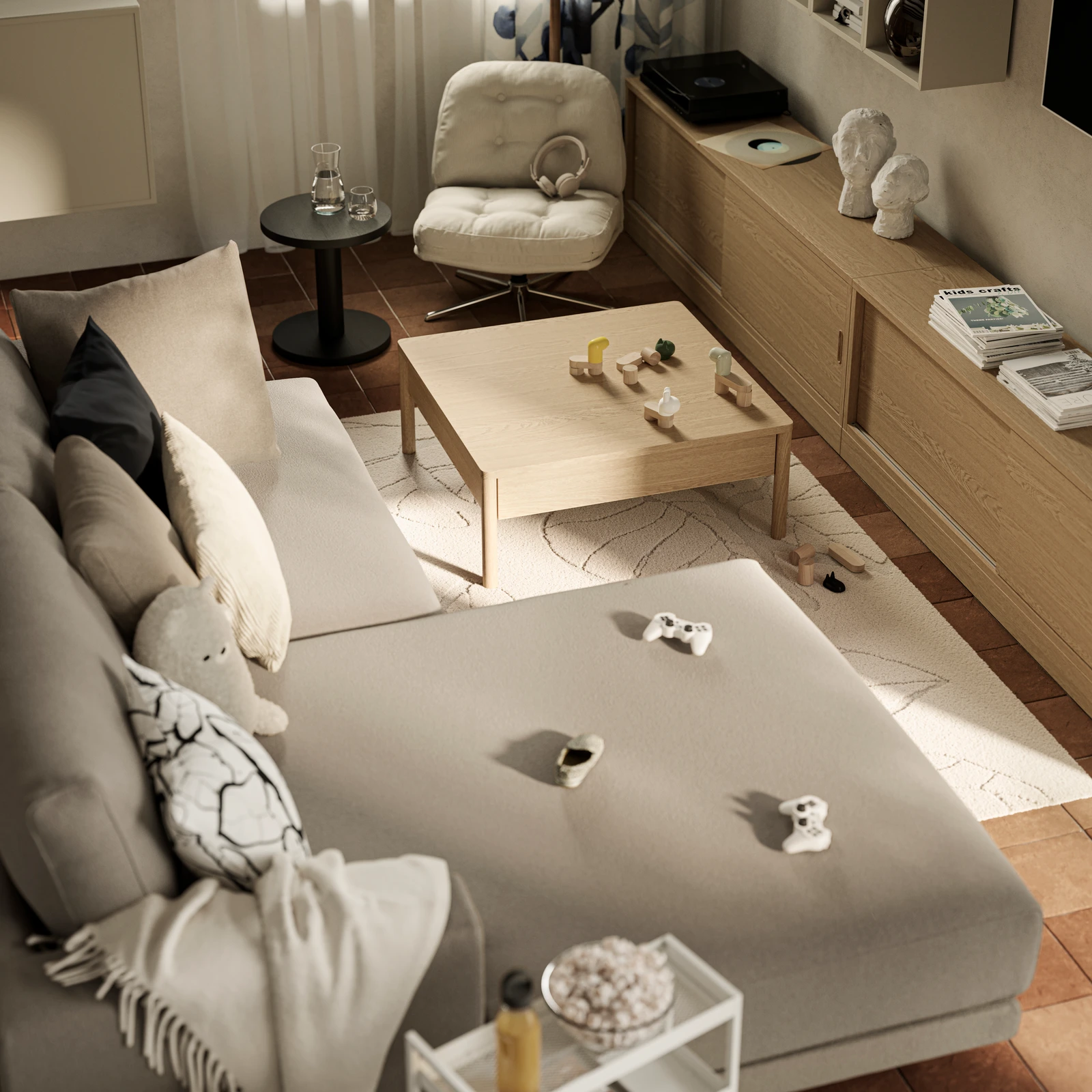 Choose the format according to the room’s geometry and how many people need a seat at the same time.
- Two-seater sofas can suit compact rooms, couples or homes where armchairs provide additional seating. They can preserve more open floor area, but may be limiting for regular entertaining.
- Three-seater sofas offer more shared seating along a single wall. Check the full width including arms, not just the apparent seat area.
- Chaise sofas add a place to put up your feet without the footprint of a separate footstool. Decide which side the chaise needs to sit on from the room entrance and main walkway; the wrong orientation can obstruct circulation.
- Corner sofas can make use of two walls and group several people together. They are not automatically the best small-room answer: an oversized corner can dominate the room or block access.
- Modular sofas can be useful where layouts change, households grow or a room has an awkward shape. Their value depends on the available configurations, dimensions and terms for the specific range.
IKEA currently groups these formats as distinct sofa categories, including modular, corner and chaise options.[^1] Its SÖDERHAMN range also illustrates the general idea of combining sections to suit a space and way of living.[^2] Use that as a prompt to check the exact configuration of any model you are considering, rather than assuming every modular system offers the same pieces or flexibility.
Match comfort to daily routines
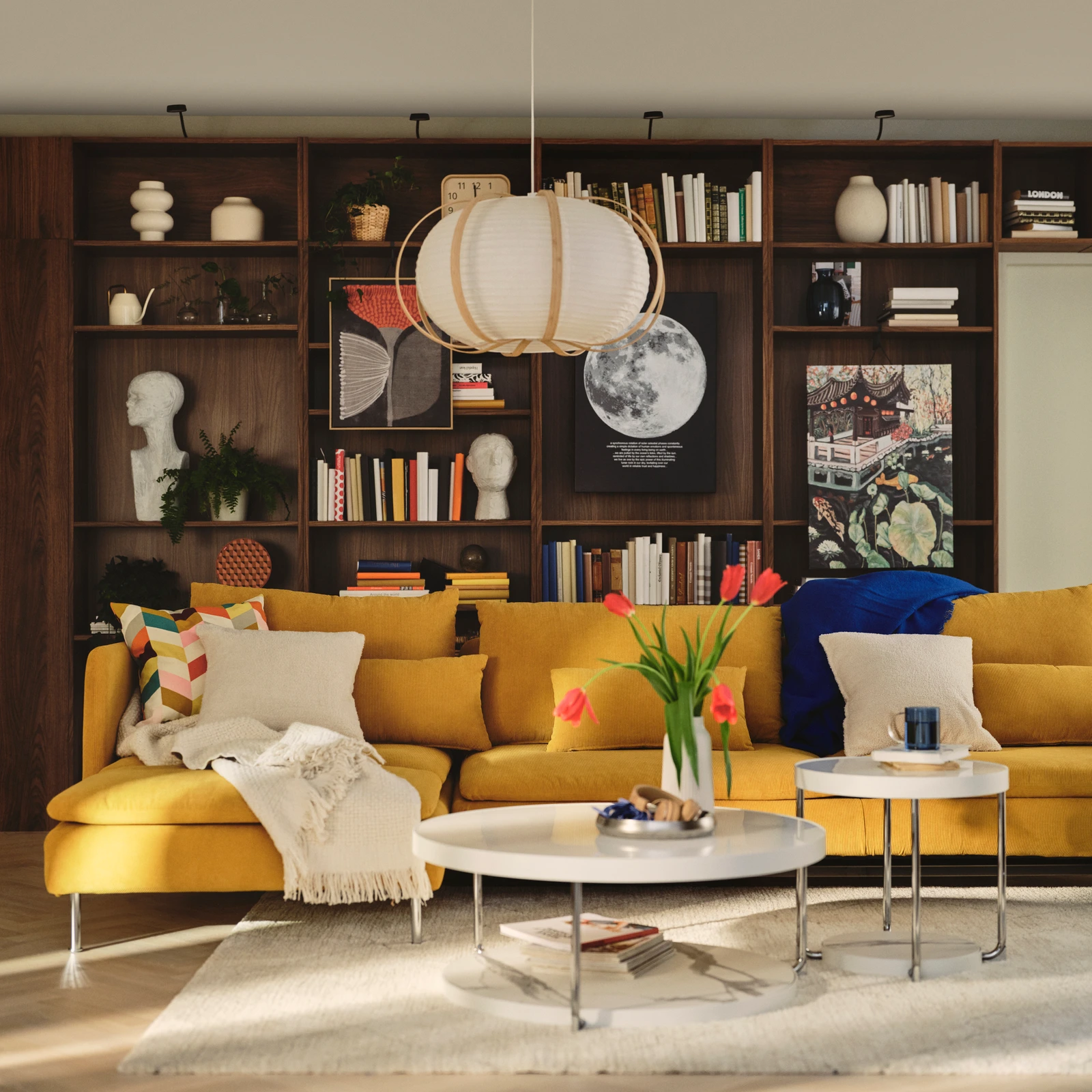 Comfort is not one setting. A household that mostly lounges may prefer a different seat and back feel from one that needs a supportive place for reading, video calls or entertaining. Sit on shortlisted models where possible, and give each person who uses the sofa regularly a chance to assess it.
Consider seat depth in relation to how you sit. A deeper seat can support a more relaxed position, while some people may prefer the feel of a more upright posture. Back cushions, arm shape and seat height also affect how easily people settle in and get up. Avoid assuming that a deep seat alone guarantees comfort.
Think about capacity and roles. A sofa may be the main seating, one part of a wider arrangement with armchairs and footstools, or a guest bed. IKEA’s living-room page describes a seating family that can include armchairs, chaise longues, footstools and a sofa-bed option, and notes that loose back cushions can be arranged for lounging or upright sitting.[^2] That demonstrates why the intended activity matters: compare the specific model’s current dimensions, mechanism and instructions before relying on a feature.
Balance upholstery, colour and care
Choose upholstery with the people, pets and daily wear in mind. A pale or heavily textured finish may be the look you want, but it can demand more attention in a home with muddy paws, young children or frequent snacks on the sofa. Strong sunlight, denim transfer and the likelihood of spills should also influence the shortlist.
Start by checking the retailer’s current care instructions for each exact cover or upholstery option. Note whether covers are removable, what cleaning is permitted and whether replacement covers are available; these details vary by model and material. Do not rely on a material label alone to predict stain resistance, durability or ease of cleaning.
Colour works best when it supports the care plan. Mid-tones or patterned finishes may make everyday marks less immediately visible, while a lighter sofa can work well if the household is comfortable with the specified cleaning routine. Texture changes both appearance and the way a sofa feels to sit on, so view a sample or the product in person where practical. IKEA’s sofa guidance includes material and colour among the choices that should be considered alongside size and shape.[^1]
Compare long-term value before the price tag
The cheapest headline price is only one part of value. Compare what each option is likely to require over its ownership period: expected use, care effort, replacement-cover availability where relevant, delivery and assembly charges, and the documented warranty or return terms.
Read the terms rather than treating a warranty as a blanket promise. IKEA states that its sofas come with a 10-year warranty,[^1] but that is an example of why buyers should check the current retailer-specific coverage, exclusions, claim process and the exact products included. A long warranty can be meaningful, yet it does not replace checking whether the sofa fits your needs and access route.
A flexible seating system may be worth considering if you expect to move, reconfigure the room or add seating later. Equally, a simpler fixed sofa may represent better value if it fits the room well and the household’s needs are stable. Compare like for like: the final price, applicable terms, care requirements and likely replacement pressure—not only the initial discount.
Use a final sofa shortlist checklist
Before checkout, compare each shortlisted sofa in the same order:
- Confirm its full product and package dimensions against the marked-out room footprint.
- Recheck the delivery route, narrow points and turns.
- Count regular users and define the main activities: lounging, upright sitting, guests or sleeping.
- Check the shape and orientation, especially for chaise and corner arrangements.
- Review the exact upholstery, colour and care instructions for your household.
- Read current delivery, return, assembly and warranty terms.
- Confirm all specifications on the retailer’s product page before ordering.
This final pass keeps attractive options from displacing workable ones. It also reflects the main factors IKEA identifies for sofa selection—size, material, colour, shape and design—while keeping the decision anchored in your own room and routines.[^1]
Frequently Asked Questions
How much space should I leave around a sofa?
Leave enough unobstructed space for the routes people use most, door and drawer openings, and access to nearby furniture. The right amount depends on the room and its traffic pattern, so mark the sofa footprint on the floor and walk the routes before deciding. Check the chosen model’s exact dimensions rather than estimating from an image.
Is a corner sofa always best for a small living room?
No. A corner sofa can use two walls efficiently, but it can also make a small room feel crowded or interrupt the route through it. Compare its full footprint with a compact sofa plus separate seating, and check whether the corner orientation works with doors, windows and the main walkway. IKEA lists corner sofas as one of several sofa formats, not as a universal small-space solution.[^1]
What should I check before a sofa is delivered?
Confirm product and package dimensions, the delivery route and turning points, current delivery and assembly terms, and whether the retailer requires any preparation. Check the product page and instructions for the exact model, since configuration and packaging can differ. Do this before ordering rather than relying on a general category description.
How do I choose a sofa fabric for children or pets?
Start with the household’s likely spills, dirt, pet contact and willingness to follow a care routine. Then read the care instructions for each exact upholstery or cover, including permitted cleaning and whether covers are removable. Choose a colour and texture you can realistically maintain; do not assume a fabric will be easy-care without checking the retailer’s current guidance.
[^1]: IKEA UK, Sofas [^2]: IKEA UK, Living room
Related reading
- Best sofas for UK homes: evidence-led top choices
- IKEA vs John Lewis sofas: which is the better fit
- John Lewis sofas review: who they suit and who should skip them
- How a sofa should fit, feel, and perform in a real home
Editorial information: About our editorial team · Read our editorial policy · Read our affiliate disclosure.