A furniture offer is only useful if the item still works for your room, budget and likely length of use. Start with the product you need, then compare like-for-like specifications, the full delivered cost and the practical downside if it does not suit your home.
What makes a furniture deal genuine?
A genuine deal is not simply the item with the largest percentage reduction. It is an offer on a suitable product at a lower comparable total cost, without creating avoidable compromises on delivery, returns, fit or expected use.
That distinction matters because furniture is difficult to compare at a glance. Two sofas can look similar in a promotion grid while differing in dimensions, materials, configuration, delivery terms or what is included. A low price on the wrong size, an incomplete configuration or an item that is costly to return is not necessarily a saving.
Use a simple decision standard: would you still choose this exact item if the promotion label were removed? If the answer is yes, the offer may be worth assessing. If not, pause before letting the discount define the purchase.
Then move through the comparison in order. Match the product first, calculate the delivered cost second, and check the terms that affect your ability to change course. The final checklist below turns that process into a repeatable buy, wait or walk-away decision.
Compare the product before comparing the price
Compare products by the usable outcome, not by their category name. For a sofa, confirm the overall width, depth and height, seat depth, configuration, upholstery, leg finish and whether delivery includes assembly or room placement. For storage, check internal dimensions, load requirements, wall-fixing needs and the number of units supplied.
Make a short comparison sheet with the details that would change your choice:
- Exact model, size and colour or finish
- Materials and construction details provided by the retailer
- Included components, such as cushions, shelves, mattress or fittings
- Delivery lead time, access restrictions and assembly requirements
- Care guidance, warranty information and exclusions to check before ordering
This prevents a common false comparison: placing a discounted base model beside a more fully specified alternative. If one price includes a larger configuration, upgraded material or a service you would otherwise pay for, the prices are not directly comparable.
Also test the item against the real room. Measure the intended space, doorways, stairs and lift access where relevant. Mark out the footprint with tape if that will help. A purchase that cannot be delivered easily or leaves the room awkward to use can turn a headline saving into an expensive correction.
Once the specification is genuinely comparable, move to total delivered cost. Then use the return checks to decide whether the cheaper option carries a practical risk you would rather avoid.
Calculate the true delivered cost
The figure to compare is the cost of getting the same usable item into your home, not the price shown in the product tile. Write down the item price, then add every unavoidable charge and subtract only reductions you can actually use.
A practical calculation is:
true delivered cost = item price + delivery + assembly or access charges + required extras - valid discounts
Required extras might include feet, fittings, protective treatment, a compatible mattress, replacement cushions or collection charges that apply to your chosen configuration. Do not include a voucher unless you meet its conditions and it applies to the exact item in the basket.
Compare timings as well as totals. A lower price may be less useful if it arrives after a move-in date, renovation milestone or planned replacement. Conversely, paying a little more for a suitable delivery slot can be sensible when it avoids temporary furniture, storage or disruption.
Keep evidence while you compare: screenshots or saved pages for the configuration, basket total, delivery estimate, promotional wording and terms. Retailer pages and promotions can change, and a record helps you check that the checkout total still matches the offer you evaluated.
Avoid treating a crossed-out price as proof of value by itself. The meaningful question is whether your selected, fully specified option costs less than an equivalent alternative after all charges. If it does, and the product and terms remain suitable, you have identified a potentially genuine saving.
Check returns before treating a discount as a saving
AI-generated generic editorial illustration — not a retailer product photo and does not depict the reviewed product or service. Make return-window and refund-condition differences easy to weigh alongside a discounted price.
 A discounted furniture purchase can be less flexible than it first appears, so read the return policy before ordering—particularly for bulky items, made-to-order choices or purchases you have not seen in person.
The supplied Dunelm policy says its change-of-mind policy allows returns of eligible products within 28 days of purchase, subject to exclusions. It also states that applicable refunds are made to the original tender type and that a refund is limited to the amount paid, not any saving represented by a discount code. Dunelm’s returns policy
The supplied Habitat policy says a change-of-mind return can be requested within 30 days of collection or delivery. It says the item should be unused, complete with original components, in original packaging where applicable, and in re-saleable condition; it also lists proof of purchase and any free items supplied as things to provide. Refunds are processed to the original payment method, with timing and inspection conditions described in the policy. Habitat’s returns and refunds guide
These policies illustrate why a one- or two-day difference in a return window is only one part of the comparison. Check eligibility for your exact product, condition and packaging requirements, collection arrangements, proof-of-purchase requirements, exclusions and the route for the refund. Retailer terms can change, so confirm the live policy at checkout.
If you would need to open, assemble or use the item before knowing whether it suits the room, factor that uncertainty into the value of the offer. A slightly higher-priced option with terms you can realistically meet may be the safer purchase.
Judge value by fit, durability and usable life
The cheapest suitable item is not automatically the best value, and the more expensive item is not automatically the longer-lasting one. Judge value by the period in which the furniture is likely to work for your household.
Start with fit. Consider room size, daily traffic, children or pets, cleaning needs, storage requirements and whether the layout may change soon. A compact dining table that works on ordinary days but cannot accommodate regular guests may still be the right choice; it simply should not be compared as if it served the same purpose as a larger table.
Then assess what the retailer actually specifies. Look for material descriptions, care instructions, weight or load guidance where relevant, replacement-part availability, assembly requirements and warranty scope. Treat vague impressions as prompts for further checking rather than proof of durability.
Useful life is also personal. A renter planning a near-term move may value lighter, adaptable furniture. A household furnishing a long-term home may put more weight on repairability, practical upholstery and a configuration that can continue to work as needs change.
Ask one final question: if the item needed replacing sooner than expected, would the apparent saving still feel worthwhile? That question brings price, suitability and risk into the same decision.
Use promotions without being led by them
Promotions work best after you have selected a shortlist. If you begin with the sale page, it is easy to buy an item because it is reduced rather than because it solves the problem you set out to solve.
Use an offer as a prompt to re-check a chosen product, not as a reason to abandon your criteria. Confirm the exact configuration, compare the delivered total, read any offer conditions and keep the return policy in view. A bundle can be useful only when every included item is wanted; a minimum-spend incentive is useful only when it does not add unnecessary purchases.
Clearance can deserve attention, but it needs extra scrutiny. Check whether the item is an end-of-line finish, display model, customer return, incomplete set or product with restricted availability. Ask whether replacement parts, matching pieces and support information will still matter to you later.
If the offer has an end date, use that deadline to finish a fair comparison rather than to skip one. A practical pause can include measuring the room, checking access, reviewing the checkout total and saving the relevant policy pages. If those checks are incomplete, waiting is often a better decision than relying on urgency.
The strongest promotion is one that lowers the cost of an item you had already established was suitable. Anything else should be treated as an invitation to investigate, not a verdict that you should buy.
A practical checklist for buying furniture on offer
AI-generated generic editorial illustration — not a retailer product photo and does not depict the reviewed product or service. Reinforce the article's practical workflow with a quick visual decision path.
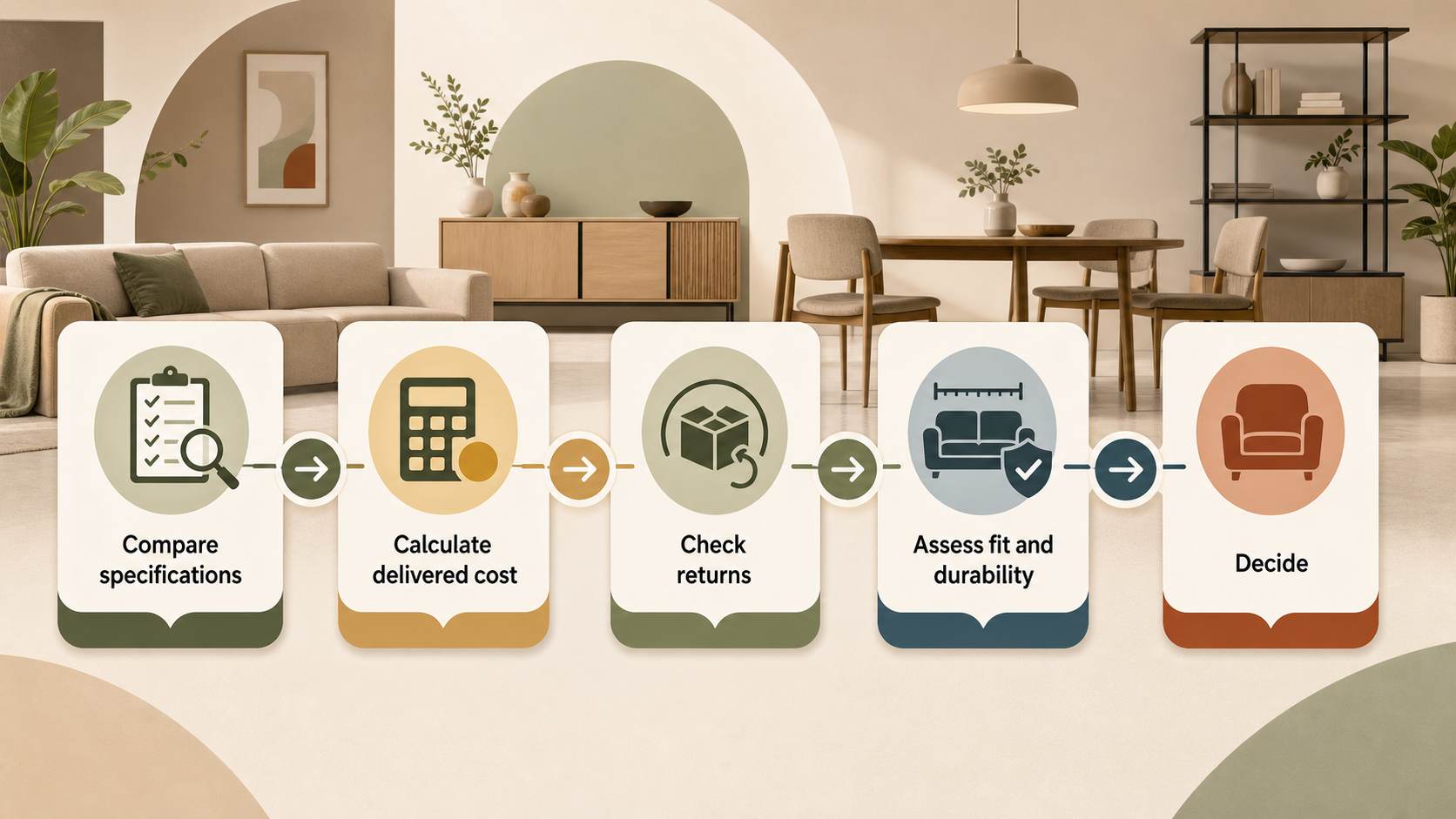 Use this sequence whenever you see a tempting price:
- Define the need. Write down the room, dimensions, function, budget and non-negotiables before browsing offers.
- Match the specification. Compare exact sizes, materials, components, finish and configuration—not just product photos or category labels.
- Check physical fit. Measure the destination room and the delivery route, including doors, stairs and lifts where relevant.
- Calculate the delivered total. Add delivery, assembly, access charges and necessary extras; subtract only discounts that apply to your order.
- Read promotion conditions. Confirm dates, exclusions, minimum spends, bundle requirements and whether the offer applies to your selected variation.
- Check returns realistically. Read the live retailer policy for the exact product and consider the condition, packaging, collection and evidence you would need.
- Review care and likely use. Decide whether the material, configuration and maintenance requirements suit your household over time.
- Save the evidence. Keep the product page, basket total, promotion wording, delivery estimate and order confirmation.
- Choose deliberately. Buy when the comparable total and terms work; wait when information is missing; walk away when the discount is doing all the persuading.
This process is deliberately less exciting than a flash-sale countdown, but it is more likely to protect the saving you think you are making.
Frequently Asked Questions
Are clearance furniture deals always worth considering?
No. Clearance can be worthwhile when the exact item meets your needs and the lower price reflects a trade-off you understand. Check the specification, condition, availability of matching items or parts, delivery terms and return eligibility. If the item is only attractive because the reduction is large, compare it with a suitable non-clearance alternative before deciding.
How do delivery and return terms affect whether an offer is good value?
Delivery charges and required services change the true delivered cost. Return terms affect the cost and difficulty of correcting a mistake. The supplied policies show that change-of-mind conditions can differ: Dunelm describes a 28-day eligible return window, while Habitat describes 30 days from collection or delivery alongside condition, packaging and proof-of-purchase requirements. Confirm the live terms for your item before buying. Dunelm’s returns policy Habitat’s returns and refunds guide
Should I buy furniture during a sale or wait for a better promotion?
Buy during a sale when the exact item is suitable, the full delivered cost fits your budget and the terms are acceptable. Wait when you still need to measure, compare specifications, check policy conditions or decide whether the item will work long enough for your household. A possible future discount is less important than avoiding an unsuitable purchase now.
What evidence should I save before placing an order?
Save the selected configuration, listed price, basket total, delivery estimate, offer wording and terms, return-policy page and order confirmation. If the retailer provides warranty or care information that matters to your decision, save that too. These records make it easier to check the order before payment and to refer back to the terms you reviewed.
Related reading
- Dunelm sofas review: practical buying assessment
- Habitat sofas review: practical buying assessment
- How to choose a sofa for your room and daily life
- When to buy furniture for better value
Editorial information: About our editorial team · Read our editorial policy · Read our affiliate disclosure.